
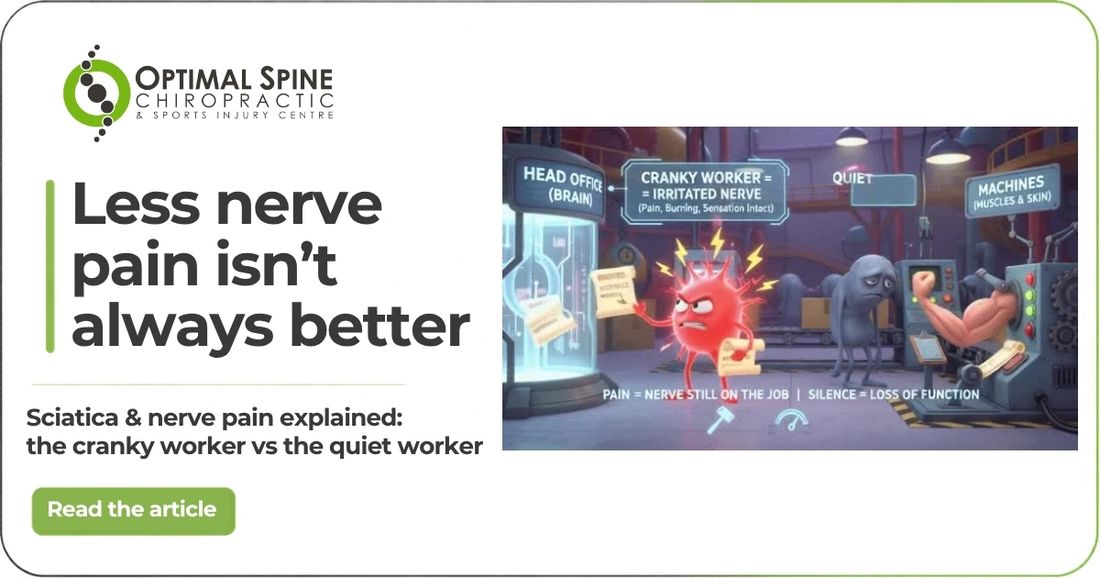
When a nerve is irritated by a disc injury or narrowing near the spine (radiculopathy), the goal is simple: stop it getting worse, then help it recover. Pain is only part of the picture, so the first thing we do is check how well the nerve is actually working.
That check gives us an accurate baseline. We test three things:
01
Strength
The muscles each nerve controls.
02
Reflexes
Deep tendon reflexes, such as the knee or ankle tap.
03
Sensation
The skin areas each nerve supplies.
We repeat these tests as you go, so we know whether the nerve is truly improving, not just hurting less. Below, we explain nerve pain at three levels. Read as far as you like.
Level 1: The cranky worker and the quiet worker
Think of each nerve as a worker on a factory floor. Its job is to carry messages between head office (your brain) and the machines (your muscles and skin). It delivers orders out ("contract that muscle") and brings reports back ("something is touching the foot").
The cranky worker
Some days a worker is grumpy. He complains loudly, but every order still gets delivered and every report comes back. This is an irritated nerve: you feel pain, burning or pins and needles, but your strength is normal and you can still feel everything.
The quiet worker
The worker who worries us more has gone quiet. You barely notice him, but jobs are no longer getting done. This is a nerve that has stopped conducting well. It may hurt less, but now there is weakness (orders not delivered) and numbness (reports not returned).
The key message
Pain is unpleasant, but it often means the nerve is still on the job. When a nerve's function drops, pain can ease and be replaced by weakness and numbness. That can feel better, but it is not always a sign of recovery. This is why we keep testing strength, reflexes and sensation rather than relying on pain alone.
Level 2: How nerves work
The nerves to your arms and legs leave the spinal cord as nerve roots, which pass through small openings between the vertebrae. Each root does two jobs:
Motor (outgoing)
Carries signals from the brain and spinal cord to muscles, so they contract with force.
Sensory (incoming)
Carries information from skin, joints and muscles back to the brain, so you feel touch, temperature, position and pain.
Each root supplies a predictable patch of skin and set of muscles. That is why a problem at one spinal level causes symptoms in a specific strip of the arm or leg, such as sciatica running down the back of the leg.
A disc bulge or herniation can affect a nerve root in two ways. It can press on it, and the disc material can chemically inflame it. A mildly affected nerve becomes sensitive and noisy (pain, tingling). A more affected nerve starts to lose its ability to send signals (weakness, numbness, reduced reflexes).
Level 3: The neurology in more detail
Clinicians sort nerve root symptoms into two groups, and they mean very different things.
The cranky worker
Positive symptoms: the nerve is overactive
Pain, burning, electric shocks and pins and needles. Leaking disc material releases inflammatory chemicals (such as TNF-alpha and interleukins) around the nerve root and its dorsal root ganglion. Inflamed sections of nerve can fire on their own (ectopic firing) and become sensitive to stretch and pressure (mechanosensitivity). The nerve is noisy, but signals still pass along it.
The quiet worker
Negative symptoms: the nerve is under-conducting
Weakness, numbness and reduced or absent reflexes. Sustained pressure reduces blood flow to the nerve root and can damage its insulating myelin sheath, so signals slow down or are blocked. The large fibres that carry muscle commands, light touch, vibration and reflex signals tend to be affected first.
Why reflexes matter. A tendon reflex is a simple loop: tapping the tendon stretches the muscle, a sensory signal travels in through the nerve root, and a motor signal comes straight back out to contract the muscle. No brain decision is needed. If the reflex is reduced, part of that loop is not conducting well. It is an objective sign that doesn't depend on how much pain you feel.
Recovery takes time. Inflammation can settle within weeks. Repairing myelin or regrowing nerve fibres is slower, and sensation often returns gradually. As a numb area wakes up, it can tingle for a while, so new pins and needles can be a sign of recovery rather than worsening.
How we assess and monitor your nerves
Every nerve root has its own muscles, reflex and skin area, so testing them tells us which nerve is involved and how well it is working.
| Nerve root | Muscle we test | Reflex | Skin area |
|---|---|---|---|
| C5 | Lifting the arm out to the side | Biceps | Outer upper arm |
| C6 | Bending the elbow, wrist extension | Brachioradialis | Thumb side of forearm and hand |
| C7 | Straightening the elbow | Triceps | Middle finger |
| L4 | Lifting the foot up (ankle) | Knee | Inner shin |
| L5 | Lifting the big toe | No reliable reflex | Top of the foot |
| S1 | Pointing the foot, rising onto toes | Ankle (Achilles) | Outer edge and sole of the foot |
We may also use nerve tension tests, such as a straight leg raise or slump test, to see how sensitive the nerve is to movement. We retest at review appointments and compare with your baseline.
Signs you are improving
Recovery is rarely a straight line, but these are the signs we look for:
What is not improvement: pain easing while numbness spreads or weakness increases. That is the quiet worker, and it needs prompt review.
How we help with nerve pain at Optimal Spine Chiropractic
Nerve pain responds best to a combined, personalised plan: a clear explanation, the right exercises at the right dose, and hands-on care to support them. That combination is what clinical guidelines recommend (NICE NG59), and it is how we work at Optimal Spine.
Why the right guidance matters
There are plenty of sciatica exercises online. The hard part is knowing which ones suit your nerve, how far to push, and when to change them.
- The right exercise makes a difference. In a trial of 312 people with back pain and sciatica, exercises matched to each person's preferred movement direction reduced pain and medication use quickly. Unmatched exercises did not (Long 2004). Finding that direction takes a hands-on assessment.
- The dose depends on the nerve. A cranky, irritable nerve needs gentle loading. A quiet nerve with weakness or numbness needs closer monitoring. Doing too much, or the wrong thing, can flare symptoms.
- Understanding helps recovery. In a large study, people who expected their problem to last a long time had poorer outcomes (ATLAS cohort). A clear explanation and a plan matter.
What your care includes
01
A thorough nerve assessment
We test strength, reflexes, sensation, nerve sensitivity and movement, then retest at reviews so we know you are truly improving.
02
A clear explanation and written report
You leave knowing what is happening, what to expect, what to avoid and what to do if things change.
03
Hands-on care, where appropriate
Gentle spinal mobilisation, soft-tissue work and chiropractic adjustments, always within your comfort. Guidelines support manual therapy as part of a plan that includes exercise (Phys Ther 2025).
04
Nerve flossing, taught properly
We show you how to do nerve mobilisation exercises correctly and progress them. For neck and arm nerve pain, a 2024 review of 27 studies found it reduced pain and disability (Lascurain et al. 2024).
05
An exercise program built for you
Matched to your symptoms and progressed over time, with videos in the PhysiApp app so you can do them confidently at home.
06
Working with your GP when needed
If your nerve function worsens or progress stalls, we coordinate with your GP for imaging or a specialist opinion.
Nerve flossing: sliders and tensioners
Sliders
Glide the nerve gently along its path. One end is lengthened while the other is slackened. They suit an irritable nerve.
Tensioners
Lengthen both ends at once. A stronger load, introduced once the nerve has settled.
Getting the choice and the dose right is the key. Done well, they should not leave you with more pain, tingling or numbness afterwards. This is one of the main things we coach in the clinic.
Your plan, step by step
Stage 1
Settle the nerve
Assessment, explanation, gentle hands-on care, nerve sliders and movements that ease your symptoms. You keep moving, without flaring things up.
Stage 2
Restore movement and strength
We progress the nerve exercises, continue hands-on care as needed, and build strength in the trunk, hips and legs, or the deep neck and shoulder-blade muscles.
Stage 3
Build resilience
Strength and fitness for work, sport and life. Visits become less frequent as you take over, and you leave with a plan for future flare-ups.
Throughout, we retest strength, reflexes and sensation and adjust your plan to how your nerve is responding, so your care follows how you are actually doing, not a generic recipe.
When to seek urgent care
Go to an emergency department or call 000 if you have back or leg pain with any of these:
- Numbness in the groin, genitals or inner thighs ("saddle" area)
- New difficulty passing urine, or loss of bladder or bowel control
- Weakness that is getting rapidly worse, or a foot that drops or drags
- Symptoms in both legs at once
These can signal serious nerve compression that needs same-day medical care.
Book a nerve pain assessment in Blaxland
A 60-minute first visit: a thorough nerve assessment, a clear explanation and a written report to take home. Optimal Spine Chiropractic, Shop 1, 15A Great Western Highway, Blaxland NSW 2774 (Brooklands Shopping Centre). Weekdays till 8:30 pm, Saturdays till 12 pm.
Related: Sciatica and Nerve Pain | Disc Injuries | Back Pain | Neck Pain